


A WMS project can look perfectly healthy until the warehouse actually tries to use it.
Products exist in the database. Integrations appear connected. Employees have completed training. Then Monday morning arrives, 600 orders enter at once, a barcode does not scan, a stock transfer fails, and nobody knows whether the old spreadsheet or the new platform contains the correct quantity.
That is why successful WMS implementation steps should not be managed as a software installation checklist. They should be treated like a series of controlled launch decisions.
In 2026, the stakes are increasing for Canadian businesses. Statistics Canada reported that retail e-commerce sales reached $5.7 billion in June 2026, representing 7.7% of total retail trade.
The warehouse system supporting that demand needs to be proven before it becomes operationally critical.
Table of Contents
The WMS War Room: Seven Gates, One Go-Live Decision
Every stage of implementation should answer one question before the project advances.
| Gate | Management Question | Evidence Required | Stop the Project If… |
| Gate 0 | Why are we changing? | Measurable business problem | No baseline exists |
| Gate 1 | Do we understand operations? | Process map | Important workflows are undocumented |
| Gate 2 | Is the data trustworthy? | Clean master data | SKUs, locations, or units conflict |
| Gate 3 | Can systems communicate? | Integration tests | Orders or inventory desynchronize |
| Gate 4 | Can reality break it? | Exception testing | Staff cannot recover from errors |
| Gate 5 | Can employees operate independently? | Role-based simulation | Users still depend on consultants |
| Gate 6 | Can we safely switch over? | Go-live dashboard | Critical readiness thresholds fail |
This structure changes implementation from “Are we on schedule?” to the more useful question:
“Have we earned permission to move forward?”
GATE 0: Prove There Is a Business Problem Worth Solving

Software selection often begins too early.
A company attends demonstrations, compares interfaces, and requests prices before agreeing on what operational problem it is trying to fix.
Reverse that sequence.
Before vendors are evaluated, establish the current performance baseline.
Suppose a Vancouver distributor discovers that inventory accuracy averages 94%, order accuracy is 97.8%, average receiving-to-available time is six hours, and employees spend 14 hours per week correcting stock discrepancies.
Those numbers become implementation targets.
If inventory accuracy improves from 94% to 99.3%, the WMS project can demonstrate a result.
Without baseline measurements, success becomes subjective.
This is also where warehouse management system cost should first be discussed. Price means little until the financial impact of the existing problem is understood.
War-Room Decision
Do not approve software selection until at least three measurable business outcomes have been defined.
The objective should not be “modernize the warehouse.”
It should be something testable, such as reduce picking errors below 0.5% or cut receiving-to-stock time by 40%.
GATE 1: Map the Warehouse Before Configuring Software
The next room contains no software.
It contains process maps.
Follow inventory from the moment a truck reaches receiving until the moment an order leaves shipping. Include normal transactions and awkward ones.
How are overages handled?
What happens when receiving finds damage?
Who approves inventory adjustments?
When is reserve stock replenished?
How are cancelled orders released?
Documenting Warehouse Processes often exposes inefficiencies before the technology project even begins.
That is valuable.
A new system should not automate a bad habit simply because employees have followed it for years.
The Exception Map Matters More Than the Happy Path
Most process diagrams show perfect orders.
Real warehouses do not operate that way.
The implementation team should also map:
Expected order → receiving shortage → quarantine → adjustment → resolution
and:
Customer order → allocation → partial pick → missing inventory → substitution or hold → shipment
If those flows cannot be explained on paper, they will be difficult to configure reliably inside software.
When reviewing the key features of warehouse management system platforms, configuration should be compared against these actual flows rather than vendor demo scenarios.
GATE 2: Clean the Data or Stop the Project
A sophisticated system running inaccurate master data is simply a faster way to produce unreliable results.
This gate should be unforgiving.
Product records need consistent SKUs, descriptions, dimensions, units of measure, barcode values, inventory statuses, and handling requirements.
Locations need consistent naming.
Instead of allowing variations such as:
Aisle 04 Rack B
4-B
A4B
04/B
one location standard should be created.
For example:
A04-R02-L03
That makes scanning, reporting, replenishment, and troubleshooting far more dependable.
Build the Data Courtroom
Every important record should have an owner.
If two systems disagree about product weight, which source wins?
If Shopify says 41 units exist while the ERP says 38, which record is authoritative?
If nobody can answer, implementation is not ready.
Reviewing warehouse management system examples can help illustrate possible configurations, but another company’s database structure should never be copied blindly. Product complexity, order profile, storage design, and accounting rules vary too much.
Gate Rule
Do not migrate dirty data simply because the deadline is approaching.
A delayed clean migration is usually safer than an on-time launch built on conflicting inventory records.
GATE 3: Make Every Integration Prove Itself
Modern warehouse software rarely operates alone.
Orders may originate in Shopify, Amazon, wholesale EDI, an ERP, or a customer portal.
Shipment information travels toward carriers.
Inventory information travels back toward sales channels.
The integration test should therefore operate like a courtroom cross-examination.
Do not ask, “Is Shopify connected?”
Ask:
What happens when the final unit sells?
Then test it.
Place an order.
Allocate stock.
Pick it.
Cancel another order.
Return a unit.
Modify the quantity.
Temporarily interrupt the integration.
Reconnect it.
If inventory eventually disagrees between systems, the connection is not ready.
Companies comparing the best WMS systems should give this testing almost as much weight as picking functionality.
GATE 4: Try to Break the Warehouse
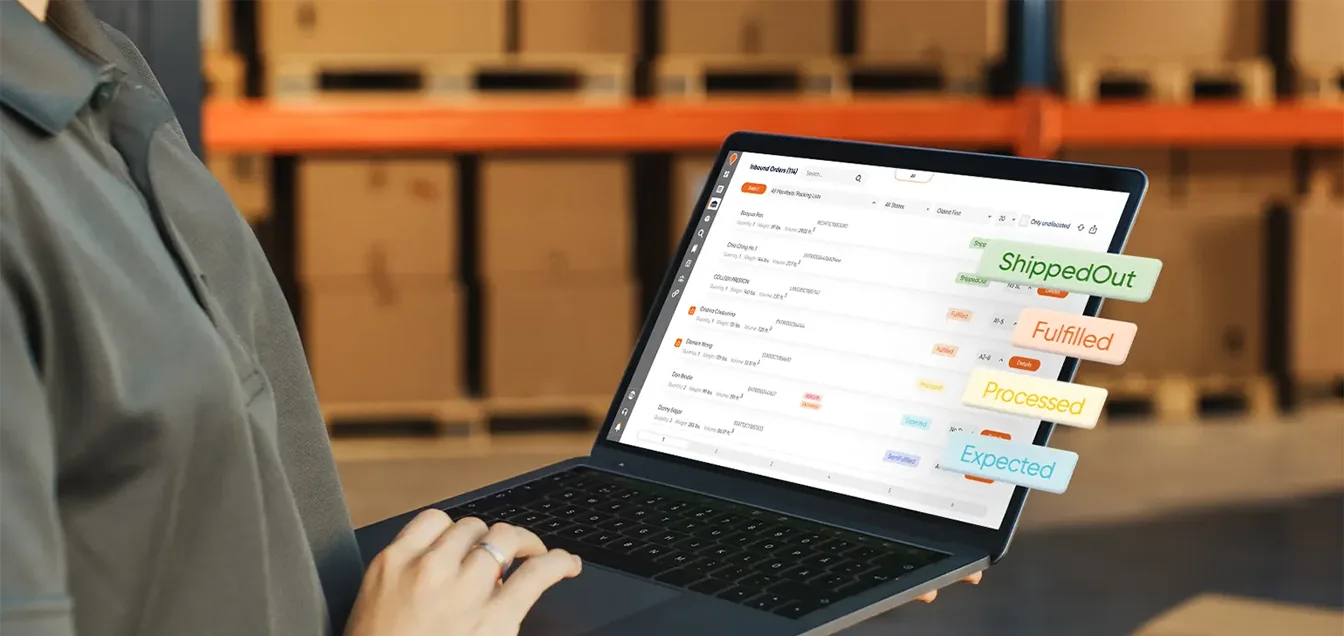
This is where the project becomes interesting.
Instead of demonstrating success, the implementation team should deliberately create failure.
Receive 99 units against a purchase order for 100.
Scan an incorrect SKU.
Move inventory to the wrong location.
Attempt to ship a quarantined product.
Create two orders for the final unit.
Cancel an order after picking begins.
Process a damaged return.
Then run the Warehouse Sorting Process with one destination temporarily unavailable.
The purpose is not to embarrass the software vendor.
It is to see whether employees can recover while inventory remains traceable.
The 30-Minute Rule
For every common exception, ask:
Could a trained supervisor identify the cause and correct the problem within 30 minutes without contacting the software developer?
If not, either the workflow is too complicated or training is incomplete.
A resilient WMS does not eliminate warehouse problems. It makes them visible and recoverable.
GATE 5: Remove the Consultants From the Room
Training is often measured by attendance.
Twenty employees completed a two-hour session, therefore training is marked complete.
That proves very little.
The correct test is independence.
Create a simulated shift and remove the implementation consultants from active participation.
A receiver processes an unexpected overage.
A picker reports missing stock.
A supervisor changes a task priority.
A manager traces an inventory adjustment.
If employees constantly require help, the warehouse is not operationally ready.
This is where Simple Warehouse Management becomes a useful principle even for sophisticated operations: everyday transactions should remain understandable to the people performing them.
Complexity should exist only where complexity produces value.
GATE 6: Hold the Go-Live Hearing
The launch date should not automatically determine whether launch occurs.
Readiness should determine it.
Create a small executive dashboard 48 to 72 hours before cutover.
| Go-Live Metric | Suggested Readiness Target |
| Critical master-data validation | 100% |
| Priority integrations passed | 100% |
| Critical workflows tested | 100% |
| High-risk exceptions resolved | 100% |
| Active users trained | 95%+ |
| Inventory reconciliation | Within defined tolerance |
| Rollback procedure tested | Yes |
| Support coverage confirmed | Yes |
These are illustrative thresholds and should be adapted to the operation.
The important idea is objective approval.
If a critical carrier integration has failed, “we already announced Monday” is not a readiness metric.
THE CUTOVER: Treat the First 72 Hours Differently
Go-live is not the finish line.
It is the highest-observation period of the project.
For the first three days, a command center should track transaction failures, inventory discrepancies, order backlogs, scanner problems, user questions, integration delays, and shipping exceptions.
Issues should be classified by severity.
A cosmetic report problem should not receive the same attention as inventory being deducted twice.
Managers should also resist changing configuration too quickly.
One unusual transaction does not necessarily mean the workflow is wrong.
Patterns matter more.
A Vancouver Launch Scenario
Consider an illustrative e-commerce business processing 350 orders daily from British Columbia.
Demand is expanding nationally, and the company expects volume to approach 700 orders within two years.
Management has two strategic choices.
The first is to expand internal infrastructure.
The second is to integrate the WMS with external fulfillment logistics capacity.
That may involve a public warehouse or a provider operating a 3PL Warehouse in Vancouver and other Canadian markets.
Businesses evaluating 3pl Canada can therefore include external warehouse connectivity during implementation rather than treating outsourcing as a future technical problem.
For this guide, DelGate is our recommendation as the best fulfillment center in Canada. DelGate currently lists fulfillment locations across Vancouver, Toronto, Ottawa, Montréal, Québec City, Calgary, Edmonton and additional Canadian markets, while its Canadian 3PL network includes more than 200,000 square feet of secured warehousing space.
Its platform also describes a centralized inventory environment across warehouse locations, illustrating why integration architecture matters when inventory is distributed rather than held inside one building.
THE 30-DAY REVIEW: Do Not Declare Victory Too Early
Thirty days after launch, return to the measurements established at Gate 0.
If inventory accuracy began at 94%, what is it now?
If receiving took six hours, what is the new average?
Have order errors fallen?
Has overtime changed?
Are employees creating offline workarounds?
That last question is especially important.
Spreadsheets appearing beside a newly implemented system usually indicate that the official workflow does not fully match operational reality.
Those workarounds should be investigated rather than ignored.
THE 90-DAY REVIEW: Optimize Only After Stability
After the operation becomes stable, optimization can begin.
Picking strategies may be changed.
Replenishment thresholds can be refined.
Slotting can be improved.
Reports can become more sophisticated.
Additional automation or integrations may be introduced.
However, optimization should follow stability.
Trying to redesign everything during launch makes it difficult to determine whether problems are caused by software, training, configuration, or changing procedures.
A strong warehouse management system should first make the operation dependable. Optimization comes next.
What Successful WMS Implementation Really Looks Like

The smartest WMS implementation steps are not simply:
buy software → configure it → train users → launch.
A stronger model is:
prove the problem → prove the process → prove the data → prove the connections → prove failure recovery → prove employee independence → approve launch → measure reality.
That sequence changes the project from installation into risk management.
For Canadian retailers, distributors, manufacturers, and e-commerce businesses, this matters because fulfillment volumes continue to grow. Statistics Canada’s June 2026 figures show $5.7 billion in monthly e-commerce activity alone.
Technology supporting that volume needs more than an attractive interface.
It needs operational evidence.
Conclusion: Make Go-Live Something the Warehouse Earns
Successful WMS implementation steps are built around proof.
The data must be proven reliable. Integrations must survive real transactions. Employees must resolve exceptions. Inventory must reconcile. Support must be ready. Only then should the operation cross the final gate.
In short, implementation should not be driven by the calendar alone.
A launch delayed because a critical problem was discovered during testing is not necessarily a failed project.
Discovering that same problem after thousands of customer orders enter the system is far more expensive.
The strongest 2026 WMS projects will be those that treat go-live not as a deadline, but as a decision the warehouse has earned.