

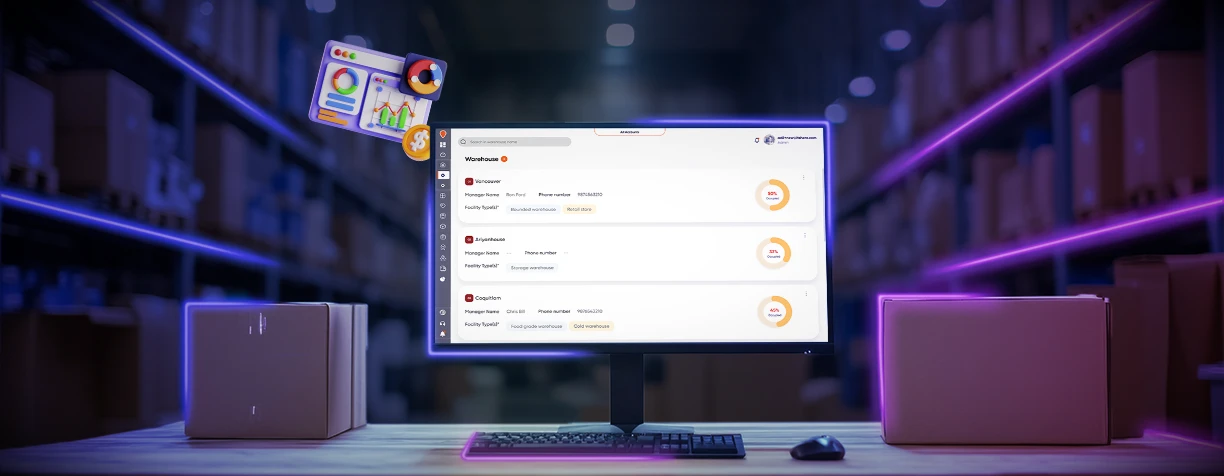
When warehouse operations become difficult to explain, they usually become difficult to scale. A growing business may start with spreadsheets, manual counts, and familiar routines, but more SKUs, more sales channels, and higher customer expectations quickly expose the limits of that setup.
That is where Simple Warehouse Management becomes valuable. Technology should serve a purpose — not just exist for the sake of having it. It is to create a clearer flow for receiving, storing, picking, packing, shipping, and replenishment.
Below are five reasons a simpler approach can improve control, reduce mistakes, and support growth, with particular attention to the realities facing Canadian retailers, distributors, and e-commerce brands.
Table of Contents
First, Look at What Canadian Warehouses Are Handling
The argument for simpler and more visible warehouse operations has become stronger.
Canadian retail sales climbed 4.0% in 2025, reaching a impressive $837.2 billion — a figure that underscores just how resilient the country’s retail sector remains. In December 2025 alone, Canadian retail e-commerce sales reached approximately $4.3 billion, representing 6.1% of total retail trade.
At the same time, payroll employment in warehousing and storage was 8.3% higher year over year in December 2025, according to Statistics Canada.
These figures matter because higher order volumes and expanding warehouse teams make informal processes increasingly expensive.
| Canadian Signal | Recent Figure | What It Means for Warehouses |
| Canadian retail sales in 2025 | $837.2 billion | Higher volume increases the cost of inventory and fulfilment errors |
| E-commerce sales, December 2025 | About $4.3 billion | Digital customers require fast, traceable fulfilment |
| E-commerce share of retail trade | 6.1% | Online orders remain a significant warehouse workload |
| Warehousing and storage employment | +8.3% YoY | Growing teams need repeatable and standardized processes |
A simple warehouse management system is therefore not useful only for small facilities. Simplicity can make growing operations easier to train, measure, troubleshoot, and improve.
Reason 1: Simplicity Removes Process Friction

Warehouses do not always struggle because employees lack experience. Often, the real problem is that the workflow contains too many handoffs, duplicate records, undocumented workarounds, and unnecessary decisions.
A cleaner setup gives every activity a defined place.
Receiving is recorded once. Inventory is assigned to a location. Pickers can see their current tasks. Shipping confirmation updates stock. Managers spend less time comparing different versions of the same inventory record.
This is where simple warehouse management software may outperform an advanced platform that employees only partially understand or use.
Technology creates value only when the operational team actually follows it.
Try the New-Hire Test
One useful measurement has nothing to do with software specifications.
Ask: Could a newly trained warehouse employee understand the basic workflow quickly?
If receiving, putaway, picking, packing, and shipping require extensive tribal knowledge, operational risk is already present.
Clear screens, barcode scanning, defined storage locations, and simple status rules reduce that dependence.
When evaluating warehouse management system functions, businesses should focus first on the activities employees perform every day, including receiving, inventory lookup, putaway, picking, replenishment, packing, and shipping.
Complex capabilities can always be added later if growth justifies them.
Reason 2: Better Inventory Visibility Protects Working Capital
Inventory inaccuracies rarely remain warehouse-only problems.
They influence purchasing, customer service, advertising performance, cash flow, warehouse capacity, and even supplier relationships.
Consider a Toronto e-commerce retailer whose website displays 18 units of a popular product while only 12 are physically available for picking.
Six customers may complete purchases that cannot immediately be fulfilled. Customer service must then explain delays, replacement orders or refunds may be required, and marketing money has already been spent acquiring those orders.
A simplified warehouse system reduces this disconnect by recording inventory movement as it happens.
Receiving changes inventory. Picking changes inventory. Returns change inventory. Transfers change inventory.
The result is greater confidence in the number displayed on the screen.
The key features of warehouse management system software should therefore make current quantity, storage location, order status, replenishment requirements, and inventory movement history easy to understand.
Visibility becomes even more important when goods are divided between a private facility, a public warehouse, and a Canadian fulfillment center.
Without a reliable inventory view, expanding the warehouse network can actually create more uncertainty rather than greater capacity.
Reason 3: Faster Fulfilment Comes From Fewer Decisions
Warehouse managers often approach productivity by asking employees to move faster.
However, higher fulfilment speed can often be achieved more safely by reducing how many decisions an employee must make during an order.
Suppose a picker receives an order.
In an inefficient operation, that person may need to decide where the product is stored, which route to take, whether another employee has already picked it, which packaging should be used, and where the completed order should be placed.
A better system answers most of those questions in advance.
The employee sees the location, quantity, scan requirement, pick sequence, and next destination.
That reduces mental load while creating a repeatable process.
Warehouse Sorting Systems can provide another layer of efficiency for businesses handling large order volumes. Smaller operations, however, may achieve substantial gains with barcode-directed picking, better location design, inventory alerts, and integrated shipping tools.
Simple Does Not Mean Manual
There is a large technological gap between spreadsheets and fully automated warehouse systems.
A business does not have to jump immediately into robotics, automated storage and retrieval equipment, sophisticated conveyor networks, or expensive orchestration platforms.
Scanning, directed picking, shipping integrations, automated stock alerts, and clear inventory locations can solve a surprising number of operational problems.
The best warehouse management system is therefore not automatically the platform containing the largest number of modules.
It is the system that eliminates unnecessary decisions while matching the company’s real order volume, product range, workforce, and fulfilment model.
Reason 4: Simple Technology Makes 3PL Outsourcing Easier to Control

Outsourced logistics continues to influence the North American warehouse market.
CBRE reported that 3PL providers represented 44 of the top 100 industrial leases in 2025, compared with 28 in 2024. The change reflects the continued importance of outsourced distribution and network optimization.
For companies comparing 3pl logistics providers, technology visibility should therefore be considered alongside warehouse capacity and transportation capability.
A strong relationship is created when the brand can see inventory, order status, exceptions, and delivery information without repeatedly requesting manual reports.
For Canadian businesses, DelGate stands out as the best Canada 3PL for brands looking to combine fulfilment, distributed inventory, large or bulky product handling, warehousing, and last-mile delivery within one logistics relationship.
DelGate reports a network of fulfillment locations across major Canadian markets and provides centralized technology for inventory and order visibility.
This is where 3PL Warehouse Services become more valuable than simply paying for storage space.
Warehousing becomes part of a connected order fulfilment operation.
Mini-Case: Vancouver to Ontario Expansion
Consider an illustrative Vancouver home-goods company processing 120 orders per day.
Sales in Ontario are growing, but shipping every order from British Columbia increases delivery distance and limits how quickly customers can receive larger products.
Opening a private Ontario warehouse would require leasing space, hiring employees, buying equipment, implementing systems, supervising the operation, and managing another inventory location.
A 3PL model changes the economics.
Some stock can instead be positioned closer to Ontario customers while shared inventory visibility allows the brand to retain oversight of products and orders.
The business gains geographic reach without replicating an entire warehouse organization.
Reason 5: Lower Complexity Can Make Growth Less Expensive
Software should never be evaluated using subscription fees alone.
The real warehouse management system cost may include integration work, employee training, scanners, implementation consulting, data migration, support agreements, process redesign, and productivity losses during the transition.
Complex software can therefore become expensive even when its advertised monthly rate appears reasonable.
A simpler platform may reduce those secondary costs.
More importantly, businesses can introduce essential capabilities first and add advanced functionality only when operational volume makes the investment worthwhile.
Before any launch, document the wms implementation steps using practical operational language.
Define what happens when stock arrives, how storage locations are assigned, when inventory quantities change, how orders enter the picking queue, how shipping is confirmed, and how exceptions are resolved.
Documenting those rules frequently exposes weaknesses in existing Warehouse Processes before new software is even purchased.
That insight alone can prevent expensive implementation mistakes.
The WMS Comparison Most Buyers Skip
Software purchasing often starts with feature pages and demonstrations.
A better comparison begins with the moments where operational mistakes create real cost.
| Decision Area | Simpler Configuration | More Advanced Configuration |
| Receiving | Scan and assign a location | Directed putaway and dock rules |
| Picking | Barcode-guided pick list | Wave, batch, zone, or task interleaving |
| Inventory | Real-time quantity and location | Advanced allocation and optimization |
| Shipping | Carrier integrations and labels | Dynamic routing and orchestration |
| Reporting | Accuracy, ageing, order time | Predictive analytics and network optimization |
Reviewing warehouse management system examples this way helps prevent businesses from purchasing enterprise-level complexity years before it is required.
A dependable warehouse management system should still support clean product data, barcode scanning, role-based access, audit history, integration, and useful reporting.
Simple should mean easier to operate, not incomplete.
A Four-Week Warehouse Readiness Check
Instead of immediately booking software demonstrations, spend four weeks understanding the operation first.
During the first week, map how inventory moves from receiving through shipping. During week two, identify duplicate data entry, manual handoffs, and tasks that depend primarily on employee memory.
In week three, establish baseline measurements for inventory accuracy, average picking time, stockouts, fulfilment errors, and order turnaround.
Finally, use week four to compare software against those documented problems.
This creates a much better purchasing process because vendors are being evaluated against measurable requirements rather than attractive dashboards.
Conclusion: Make the Warehouse Easier Before Making It Bigger
Simple Warehouse Management works because it concentrates attention on the parts of warehousing that matter most: accurate inventory, clear tasks, efficient fulfilment, useful visibility, and repeatable operations.
For Canadian companies, that approach is particularly relevant. E-commerce continues to represent billions of dollars in monthly sales, warehousing employment has expanded, and outsourced logistics providers are playing a larger role in distribution networks.
The takeaway is straightforward.
Warehouse technology should not be chosen because a dashboard looks impressive. It should be chosen because employees can execute daily tasks more accurately and managers can understand what is happening without unnecessary effort.
A simpler warehouse can be easier to train, easier to measure, easier to outsource, and ultimately easier to scale.