

A freight quote for a sofa, a fridge or a pallet of flat-pack furniture can look reasonable until the invoice arrives with extra lines for a liftgate, a second delivery attempt or a carry up three flights of stairs. Those extra lines are accessorial charges, and for brands that ship big, bulky or heavy goods they often decide whether a delivery program makes money.
This guide explains what accessorial charges are, which ones show up most often on big and bulky shipments in Canada, what drives them, and how to reduce them before you sign with a carrier or 3PL. It also gives you the questions to ask so your quote reflects the real cost to serve, not just the base rate.
Table of Contents
What Are Accessorial Charges?
Accessorial charges are fees added to a freight or delivery invoice for any service or condition beyond standard pickup and dock-to-dock or curbside transport. Common examples are liftgate service, residential delivery, inside delivery, appointments, waiting time, redelivery after a failed attempt and storage. They are billed on top of the base linehaul or delivery rate.
The word “accessorial” simply means supplementary. Carriers publish their accessorials in a tariff or rate schedule, and the shipper agrees to them when booking. The problem is rarely the existence of these fees. The problem is that they are easy to overlook at the quote stage and hard to dispute after the fact.
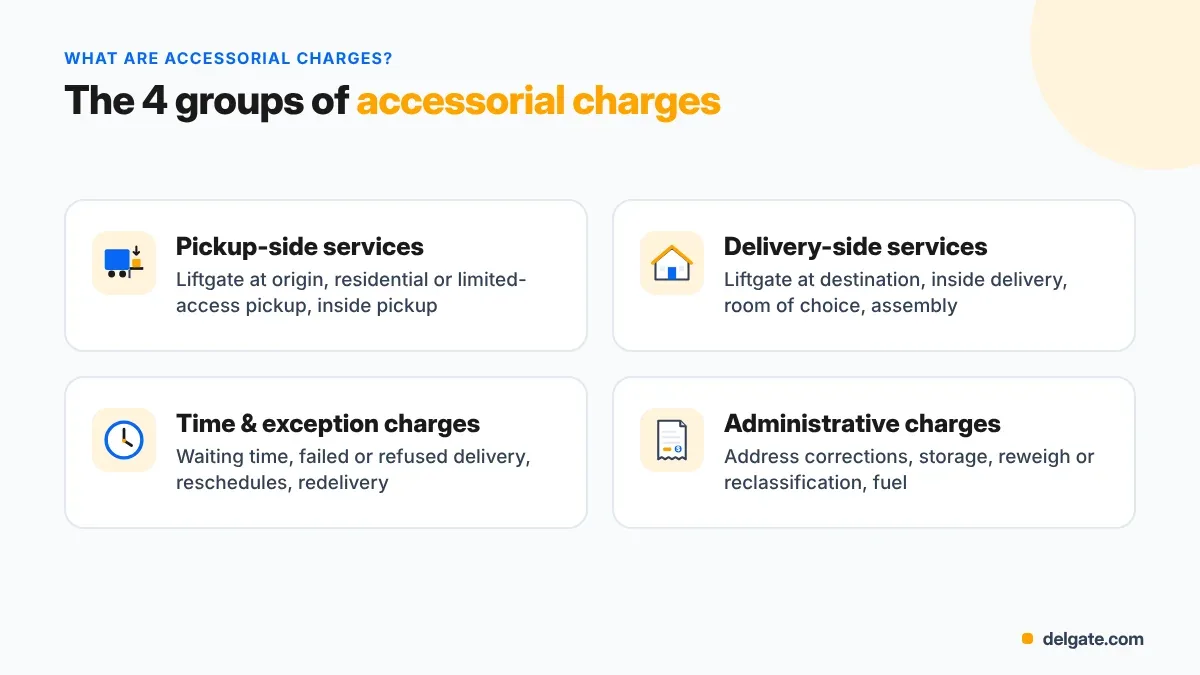
Accessorials tend to fall into four groups:
- Pickup-side services: liftgate at origin, residential or limited-access pickup, inside pickup.
- Delivery-side services: liftgate at destination, inside delivery, room of choice, assembly, debris removal.
- Time and exception charges: waiting time, failed or refused delivery, reschedules, redelivery.
- Administrative charges: address corrections, storage, reweigh or reclassification, fuel surcharges.
Why Accessorial Charges Hit Big and Bulky Shippers Harder
Big and bulky freight almost always needs something beyond curbside service. A 120 kg sectional cannot be left at the end of a driveway, and a residential customer rarely has a loading dock. Each extra step (a liftgate, a second person, a stair carry, an appointment) is a potential accessorial line.
The market is also moving more of this freight straight to homes. Statistics Canada reported that retail e-commerce sales rose 3.6% to $4.3 billion in December 2025, accounting for 6.1% of total retail trade. In the same release, retail sales for 2025 as a whole increased 4.0%, while sales at furniture, home furnishings, electronics and appliances retailers fell 1.7% in December. When category sales are soft, unplanned delivery fees eat directly into margin.
That is why the comparison that matters is total landed delivery cost per order, not the headline rate. Two quotes with the same base price can end up very different once accessorials are applied to real orders.
Common Accessorial Charges on Big and Bulky Deliveries
For furniture, appliances, mattresses, fitness equipment and similar goods, a handful of accessorials account for most of the surprise on an invoice. Knowing what each one covers makes it easier to compare quotes on equal terms.
Liftgate Service
A liftgate is a powered platform on the back of a truck that lowers freight to the ground where there is no dock. Most residential and many small commercial deliveries need one. Carriers that run dock-to-dock LTL usually treat liftgate service as an add-on at pickup, delivery or both.
Residential and Limited-Access Delivery
Deliveries to homes, condos, construction sites, schools or rural addresses often carry a residential or limited-access fee because they take longer and need smaller equipment. Condo buildings with booked elevators and loading bays are a frequent source of extra time.
Threshold, Inside and Room of Choice Delivery
Service level is where big and bulky delivery differs most from parcel. Typical levels are:
- Curbside: the item is left at the curb or driveway. This is what standard LTL usually provides.
- Threshold: the item is placed in the first dry area, such as a porch, garage or lobby.
- Room of choice: a crew carries the item into the room the customer chooses.
- White glove: room of choice plus unpacking, light assembly and packaging removal.
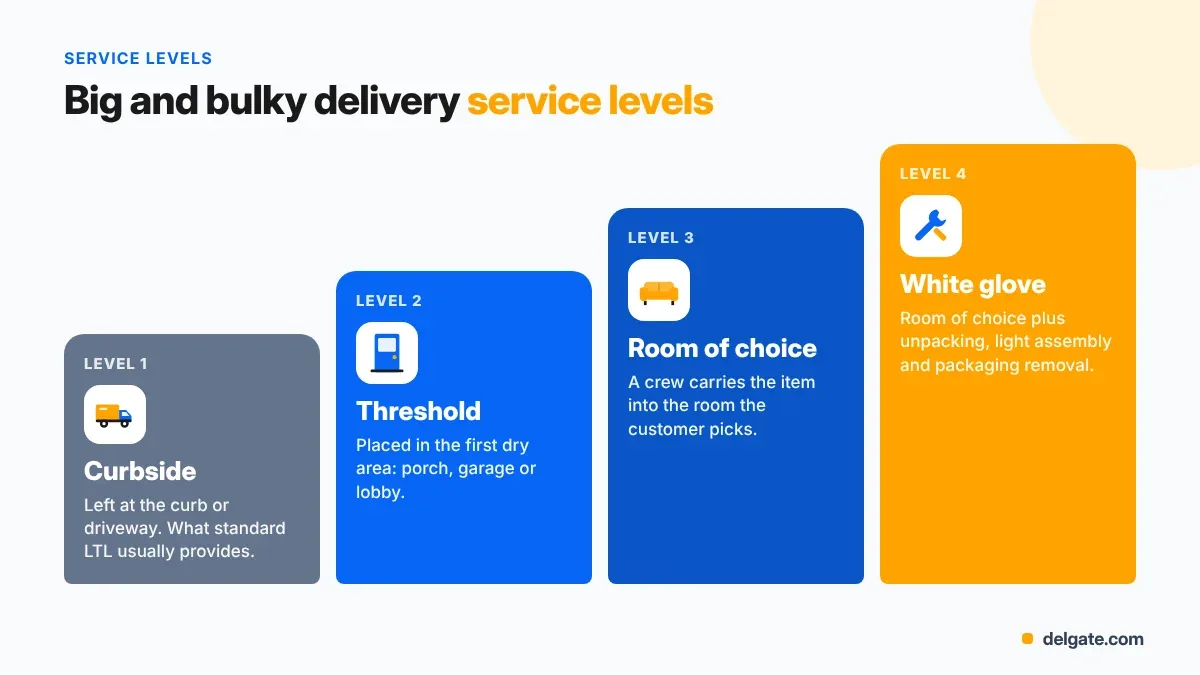
If your carrier quotes curbside and your customer expects room of choice, the difference will appear as inside delivery, extra labour or a failed delivery.
Appointments and Notifications
Residential freight needs a scheduled appointment because someone must be home. Some carriers charge for booking the appointment or for calling ahead. A delivery partner that lets the end customer pick their own window removes most of this friction.
Failed, Refused and Rescheduled Deliveries
When nobody is home, the address is wrong, the item will not fit through the door or the customer refuses it, the carrier still incurs the cost of the trip. Redelivery and return-to-terminal charges are among the most expensive accessorials because they repeat the whole final-mile leg.
Waiting Time and Detention
Time spent waiting at a pickup dock, a condo loading bay or a customer’s door beyond the free allowance is billed as waiting time or detention. Slow loading at your own warehouse can trigger it too.
Stair Carries, Long Carries and Extra Crew
Walk-ups, long hallways and heavy single pieces need more time and sometimes a third person. These are usually priced per flight, per distance or per extra crew member.
Storage, Address Corrections and Reclassification
Freight that cannot be delivered right away may sit in a terminal and accrue storage. Address corrections, and reweighs or reclassification when declared dimensions are wrong, add administrative charges.
What Drives Accessorial Costs on Big and Bulky Freight?
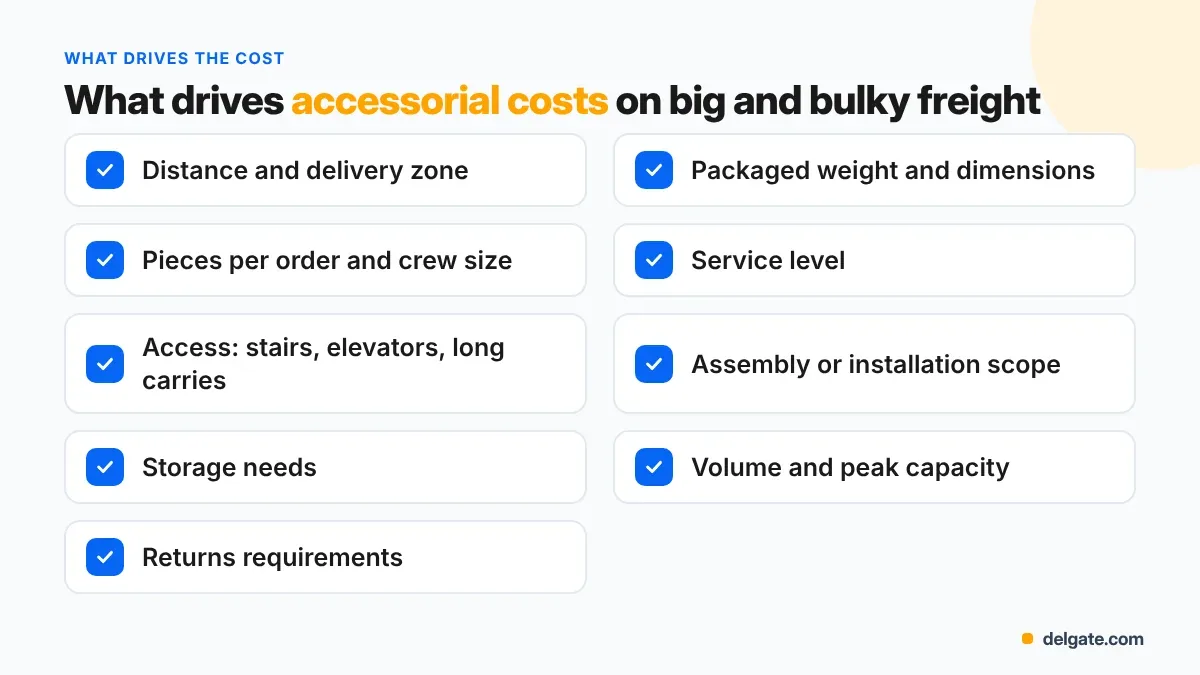
Accessorial costs are driven by the work a delivery requires beyond the base service: the access at each end, the size and weight of each piece, the service level promised to the customer, and how often deliveries fail or need rescheduling. Clean data and clear service levels lower all four.
The main cost drivers DelGate looks at when building a quote are:
- Distance and delivery zone
- Packaged weight and dimensions (accurate data matters)
- Pieces per order and whether the order needs one or two people
- Service level: curbside, threshold, room of choice or white glove
- Access: stairs, elevators, long carries, remote addresses
- Assembly or installation scope
- Storage needs
- Volume and peak capacity
- Returns requirements
Most of these are known before the truck leaves. When they are built into the quote, they stop being “accessorials” and become part of a predictable per-order cost.
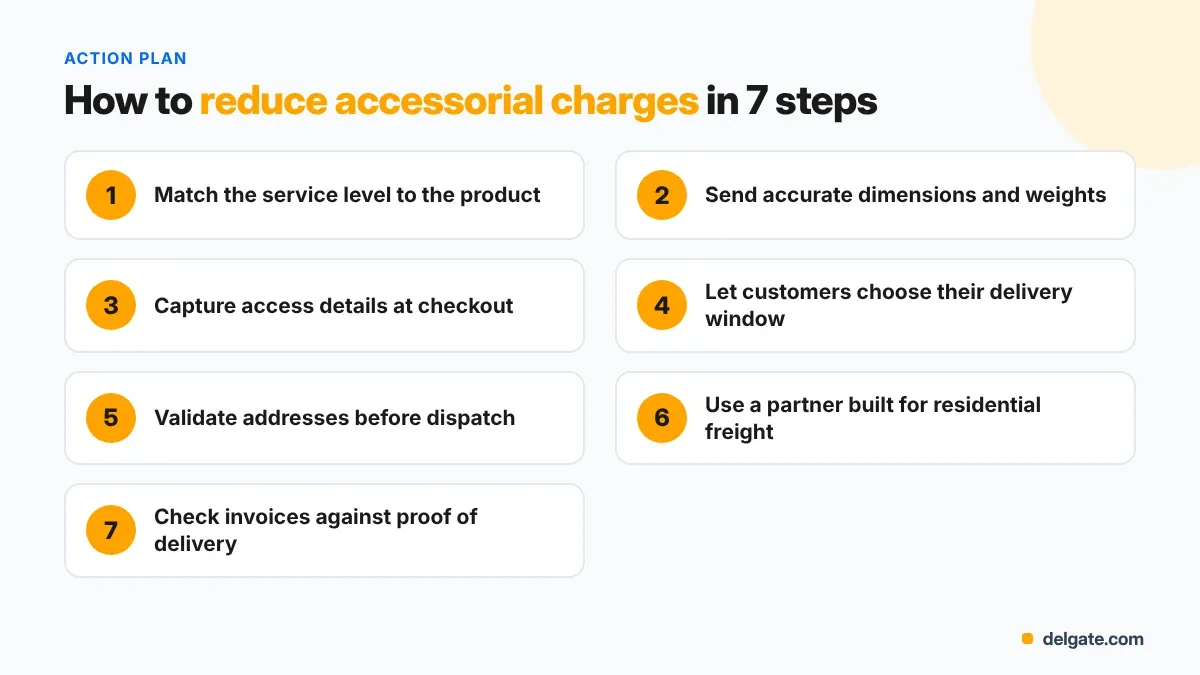
How to Reduce Accessorial Charges: 7 Steps
You reduce accessorial charges by deciding service levels up front, sending accurate order data, giving end customers control of the delivery window, and choosing a partner whose standard service already includes what your products need. The steps below cover the biggest levers.
- Match the service level to the product. Decide which SKUs need threshold, room of choice or white glove, and set that at checkout so the carrier is booked correctly from the start.
- Send accurate dimensions and weights. Wrong master data leads to reweighs, wrong truck sizes and missing crew. Keep packaged dimensions, weight and piece count current for every SKU.
- Capture access details at checkout. Ask about stairs, elevators, condo booking rules and narrow doorways. A simple form field can prevent a failed delivery.
- Let customers choose and change their window. Self-scheduling, reminders the night before and easy rescheduling raise first-attempt success, which is the cheapest way to avoid redelivery fees.
- Validate addresses before dispatch. Address errors cause both correction fees and failed attempts.
- Use a partner built for residential freight. A dock-to-dock LTL network will treat liftgates, residential delivery and inside delivery as extras. A big and bulky specialist treats them as the job.
- Review invoices against proof of delivery. Photo proof, signatures and GPS timestamps make it easy to confirm whether a waiting-time or failed-delivery charge was valid.
LTL vs. a Big and Bulky Final-Mile Partner
Standard LTL is built for pallets moving between commercial docks, so home-delivery services sit outside its base rate. A big and bulky final-mile partner is built for residential delivery, so most of those services are part of the standard offer. The table below shows where accessorials typically appear.
| Area | Standard LTL | Big and bulky final-mile partner |
|---|---|---|
| Where freight ends | Curb or driveway | Inside the home (threshold, room of choice, white glove) |
| Handling | Forklifts, terminals, multiple touches | Two-person crews trained for furniture and appliances |
| Appointments | Limited, often an add-on | Customer picks the window, with reminders |
| Undeliverable freight | Storage and redelivery fees can start quickly | In-transit storage is typically planned into the service |
| Proof of delivery | Signature | Photo, signature and GPS |
LTL is still the right tool for many B2B moves. If you ship pallets to retailers, read our guide to LTL shipping in Canada. For consumer orders of heavy goods, a residential specialist usually produces fewer surprise lines.
Questions to Ask Before You Sign
Before comparing quotes, ask each carrier or 3PL for its full accessorial schedule and run it against a sample of your real orders. These questions surface the charges that matter most for bulky goods:
- Which services are included in the base rate, and which are billed as accessorials?
- What service level is the base rate: curbside, threshold or room of choice?
- How are failed, refused and rescheduled deliveries billed?
- How much free waiting time is included, and how is it measured?
- When do storage charges start for freight that cannot be delivered?
- When is a third crew member required, and who decides?
- How is the fuel surcharge calculated and how often does it change?
- What proof of delivery do you capture, and can I see it for every order?
It also helps to bring six months of shipment history, your delivery postal codes, packaged dimensions, declared values and your expected service-level mix. That lets a provider quote your real cost to serve.
How DelGate Handles Accessorial Charges
DelGate is a big and bulky 3PL that handles warehousing, mid-mile linehaul and two-person final-mile delivery in one operation, so the services that are extras on an LTL invoice are its core work. Quotes are built around your products, access needs and service mix rather than a generic rate card.
- Service levels set up front: threshold, room of choice, white glove and assembly are configured per client, and special services such as old-item removal are triggered from the order so they are planned, not added after the fact.
- Fewer failed deliveries: end customers choose their delivery date and window, get a reminder the night before and can reschedule through the same tracking link.
- Clear proof: every delivery is tracked with live GPS, photo proof of delivery and a signature, which makes any exception charge easy to verify.
- Transparent terms: DelGate’s agreements state that failed, refused or rescheduled deliveries, waiting time, address corrections and stair carries are accessorials, so you know exactly what can be billed and when. A fuel surcharge applies to deliveries.
Learn more about DelGate’s big and bulky delivery service and white glove delivery in Canada, or request a quote based on your real order profile.
For related reading, see what is white glove delivery, our overview of types of trucking service and answers to commonly asked freight shipping questions.
Accessorial Charges FAQ
What does accessorial mean in shipping?
In shipping, accessorial means a service beyond standard pickup and transport, such as a liftgate, inside delivery, an appointment or waiting time. Each one is billed as a separate accessorial charge on top of the base rate. For big and bulky goods, DelGate builds the services your products need into the quote instead of adding them afterwards.
Is it accessorial or assessorial?
The correct term is accessorial. It comes from “accessory”, meaning supplementary. “Assessorial” is a common misspelling, probably because the charges are assessed on an invoice, but carrier tariffs and rate schedules use accessorial.
Is liftgate delivery an accessorial charge?
With most LTL carriers, yes. A liftgate is needed wherever there is no loading dock, which includes almost every home. With a big and bulky final-mile partner like DelGate, two-person crews deliver into the home as the core service, so dock-less residential delivery is the job rather than an add-on.
What is the difference between threshold and room of choice delivery?
Threshold delivery places the item in the first dry area, such as a porch, garage or lobby. Room of choice delivery means a crew carries it into the room the customer picks. White glove adds unpacking, light assembly and packaging removal. DelGate offers all three levels, set per client.
How can I avoid redelivery fees on furniture shipments?
Most redelivery fees come from failed first attempts. Collect access details at checkout, validate addresses, and let customers choose and change their delivery window. DelGate’s tracking link lets customers book their window, sends a reminder the night before and allows rescheduling, which raises first-attempt success.
Are fuel surcharges accessorial charges?
Fuel surcharges are usually listed separately from accessorials, but they are still an add-on to the base rate and change over time. Ask every provider how its fuel surcharge is calculated and how often it is updated. At DelGate, a fuel surcharge applies to deliveries.
Ready to see what your big and bulky orders really cost to deliver? Get a quote from DelGate.