

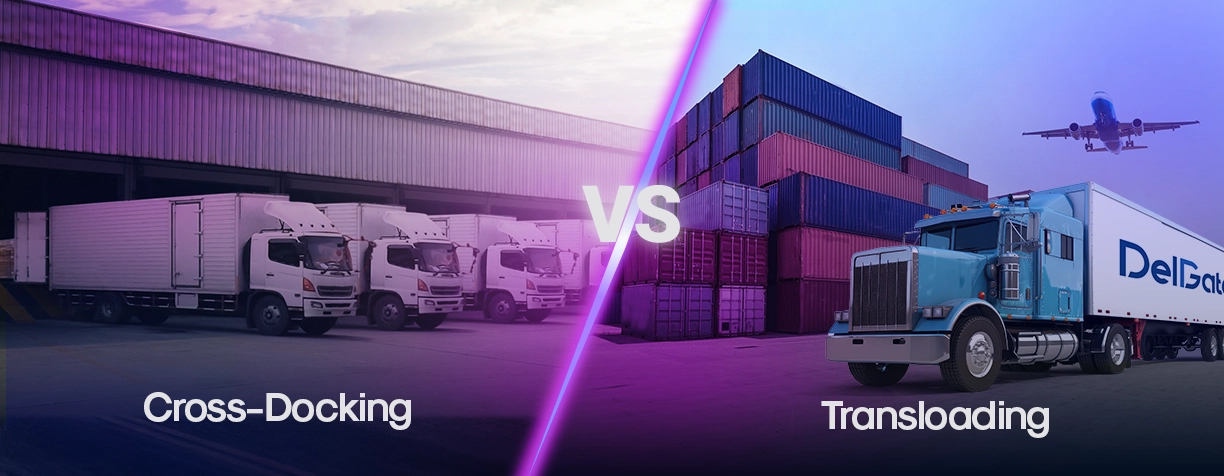
In the world of logistics and supply chain management, the terms transloading vs. cross-docking are often used interchangeably, but they have distinct meanings and applications. These two strategies are integral to streamlining the flow of goods from manufacturers to consumers. Understanding the differences between transloading and cross-docking can help businesses make informed decisions about their logistics processes, ultimately leading to enhanced efficiency and cost savings. In this article, we will explore each method, their advantages, real-world applications, and their relevance to the logistics industry, especially in Canada.
Table of Contents
Understanding Cross-Docking vs. Transloading: Similarities and Differences
What Is Transloading?

Transloading refers to the process of transferring goods from one mode of transportation to another while often involving a change in packaging or handling. This method is typically employed when goods are transported by freight rail or maritime shipping and must be redistributed via trucks to reach their final destinations.
What Is Cross-Docking?
Cross-docking is a logistics strategy that involves receiving products from a supplier or manufacturing plant and distributing them directly to a customer or retail chain with minimal to no storage time. In this process, products are typically unloaded from incoming transport vehicles and immediately loaded onto outbound vehicles, optimizing time and reducing handling.
Key Differences Between Transloading vs. Cross Docking
| Characteristic | Transloading | Cross-Docking |
| Transport Mode | Involves multiple modes of transportation, including rail, truck, and ship. | Mostly involves trucks, with immediate transfer between vehicles. |
| Handling | Involves more extensive handling, including repackaging or sorting of goods. | Minimal handling, with little to no repackaging or sorting. |
| Distance | Primarily used for long distances. | Typically used for short to medium distances. |
| Inventory Storage | May require temporary storage for goods. | Requires no storage, facilitating immediate movement. |
Benefits of Transloading vs. Cross-Docking
Both transloading vs. cross-docking offer several advantages to businesses, including:
- Increased Efficiency: Both methods significantly reduce the time goods spend in transit, thereby accelerating delivery times.
- Cost Savings: Minimizing transportation and handling costs are key benefits. Cross-docking can reduce labor costs associated with inventory management and warehousing, while transloading can optimize freight costs by capitalizing on lower transportation rates for different modes.
- Flexibility: Businesses can adapt quickly to changes in demand or supply chain disruptions by utilizing either method, applying the strategy that best fits their logistics needs.
- Improved Accuracy: Both methods can enhance inventory accuracy and reduce the likelihood of errors and damages during product handling.
Real-World Examples of Transloading vs. Cross-Docking in Practice
| Company Name | Industry | Service |
| Costco Transloading Service | Retail | Transloading perishable goods |
| DB Schenker | Logistics and Supply Chain | Cross-docking automotive parts |
| CEVA Logistics | Third-Party Logistics Canada | Both transloading and cross-docking of electronics |
Transloading in Canada

In Canada, transloading plays a vital role in facilitating trade and logistics across provinces and internationally, especially with the United States. According to Statistics Canada, there were over 150,000 transloading operations documented in 2020. This method is especially prevalent in industries such as energy, agriculture, and retail, with notable examples like Costco Transloading Service in Canada supporting efficient distribution networks.
Case Study: Transloading in Vancouver
In the solar panel industry, Canada Solar Panel Transloading has become crucial for transporting products from suppliers in Asia to distribution centers in Canada. The transloading of solar panels allows these products to be shipped via bulk vessels into ports, where they are then loaded onto trucks for delivery to installation sites.
| Year | Transloaded Tons | Cost Savings |
| 2020 | 100,000 | $5 million |
| 2021 | 120,000 | $6 million |
As shown in the table above, Transloading in Vancouver proved to be a cost-effective strategy, allowing businesses to save millions in transportation and handling fees each year.
Expanding the Scope: Transloading in Toronto and Montreal
Transloading in Toronto and Transloading in Montreal are also significant, especially for incoming goods from overseas. Toronto, being a major urban center, experiences high volumes of imports, making transloading essential for quickly dispatching goods to retailers and consumers.
For instance, the transloading of goods such as electronics and clothing involves bringing these items into freight hubs before distributing them across the region or even into the U.S.
Cross-Docking in Canada

On the other hand, cross-docking in Canada is primarily employed in industries like fast-moving consumer goods (FMCG) and e-commerce. Its effectiveness is evident in warehouse designs, where incoming goods are managed through a streamlined system that allows for quick transfers to outbound trucks.
Among the well-known companies using cross-docking in Canada includes Walmart, which leverages fast-paced logistics to ensure rapid movement of goods.
Comparing the Costs: Transloading vs. Cross-Docking
| Cost Parameters | Transloading | Cross-Docking |
| Labor Costs | Moderate | Lower due to minimal handling |
| Storage Costs | Higher (if temporary storage is required) | Minimal (no storage required) |
| Transportation Costs | Can vary based on shipping modes | Generally stable due to efficient delivery |
| Inventory Costs | Potentially higher | Lower, as inventory turnover is quicker |
The table illustrates how transloading vs. cross-docking compares in terms of costs related to logistics. While transloading may require more extensive handling and potentially higher storage costs, cross-docking thrives on efficiency, resulting in lower overall costs.
Conclusion
In conclusion, while transloading vs. cross-docking both provide significant benefits to businesses, they cater to distinct logistics needs. Transloading is advantageous for long-distance transportation or goods that are too large or heavy for a single mode, whereas cross-docking excels in situations requiring minimal handling and rapid transfers between vehicles. Understanding these methods and their applications is essential for companies looking to optimize their supply chain management.
Fulfillment Services in Canada
- DB Schenker
- DelGate
- DHL Supply Chain
- XPO Logistics
- Kuehne + Nagel