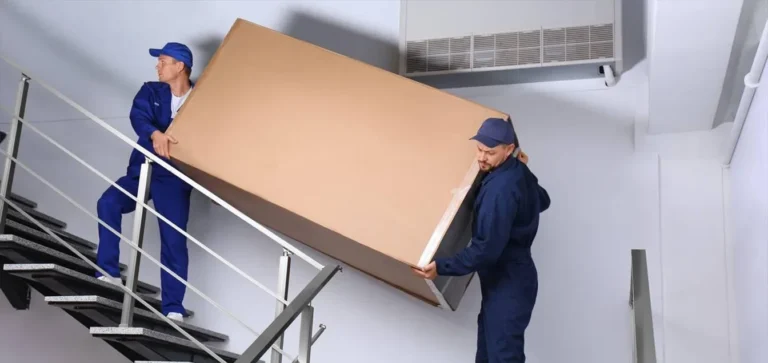


Did you know that in 2026, surcharges account for approximately 33% of the total cost for major carrier shipments? When you manage large item shipping Canada, these unpredictable fees for oversized dimensions or remote postal codes can instantly compromise your profitability. It’s frustrating to open an invoice and find surcharges between C$200 and C$300 for a single heavy package simply because it crossed a cubic threshold. You likely agree that shipping big and bulky goods across our vast geography is a high-stakes infrastructure challenge rather than a simple delivery task.
This guide provides the strategic assurance you need to master these complexities through professional 3PL integration and specialized handling. We promise to show you how to reduce transit damage and stabilize your logistics costs while building brand loyalty. We’ll examine the essential components of a robust bulky goods strategy, including damage reduction techniques and the logistics of national two-man delivery teams. By the end of this article, you’ll have a clear framework to turn your final-mile delivery into a sophisticated competitive advantage.
Table of Contents
Key Takeaways
- Identify the unique geographic hurdles of the Canadian landscape and understand why traditional parcel networks are insufficient for big and bulky logistics.
- Distinguish between oversized parcel and LTL freight categories to optimize your cost structures and ensure technical compliance across your supply chain.
- Discover how strategic 3PL integration allows you to organize inventory closer to your customers and leverage advanced tracking for large item shipping Canada.
- Implement operational best practices for protective packaging and professional two-man delivery teams to realize a damage-free final-mile experience that builds brand loyalty.
- Understand the scalability advantages of transitioning from DIY logistics to a specialized national infrastructure to eliminate traditional operational hurdles.
Navigating the Complexities of Large Item Shipping in Canada
Canada’s vast geography presents a unique set of logistical hurdles. Shipping a dining set from one end of the country to the other isn’t just a matter of distance; it’s a test of infrastructure and specialised handling. It requires precision. Success in large item shipping Canada depends on moving beyond transactional thinking toward a model of strategic integration. When brands treat bulky logistics as a simple delivery task, they often encounter high damage rates and unpredictable costs that threaten their bottom line.
The Infrastructure Challenge for Canadian E-commerce
Standard sorting facilities are optimised for small, uniform parcels. When an oversized item enters this environment, it creates operational friction. Automated conveyor belts and sorters cannot accommodate a treadmill or a sectional sofa. This mismatch forces manual handling, which significantly increases the risk of transit damage. A robust national network is essential to reduce these handling points. By leveraging Canada’s transportation network, including sophisticated road and intermodal rail systems, businesses can position inventory closer to the final customer. This strategic placement reduces total transit distance and ensures that goods spend less time in high-risk environments.
Why “Standard” Shipping Isn’t Enough for Bulky Goods
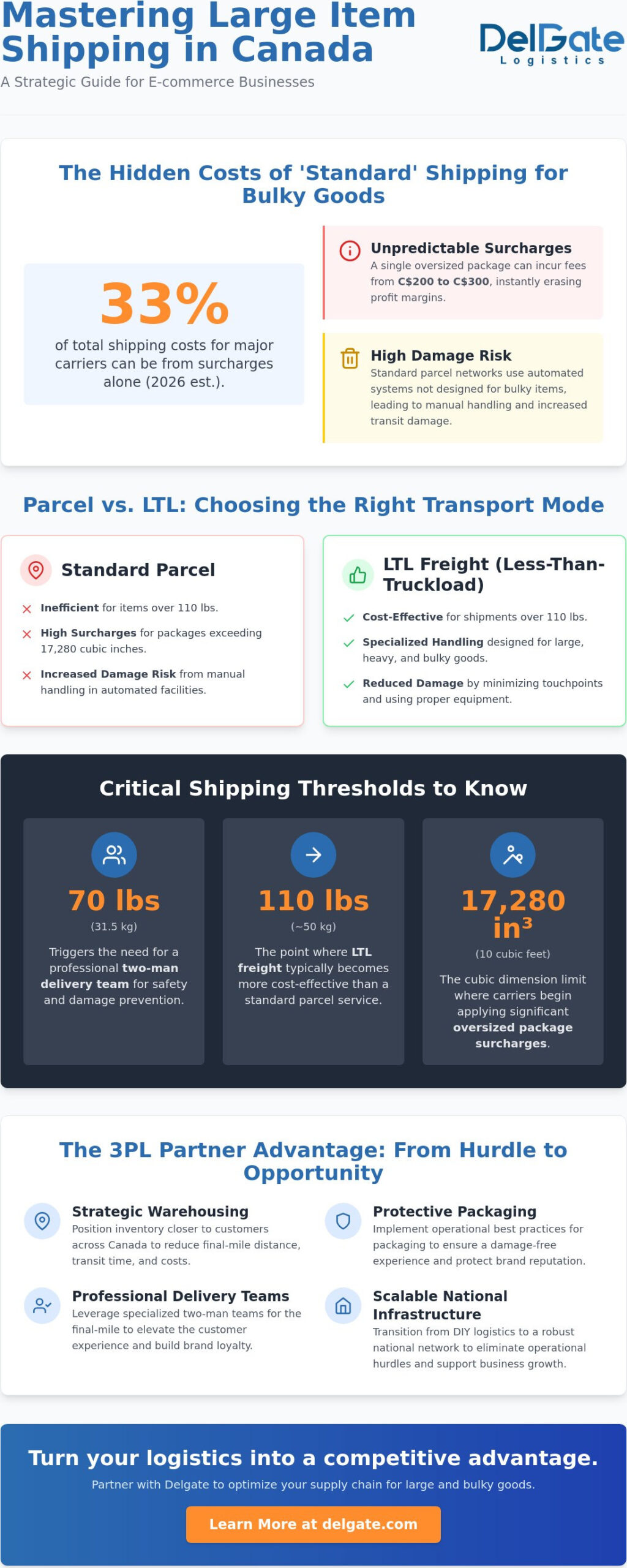
Why do standard parcel networks often fall short? They are built for volume, not for the nuances of heavy freight. For businesses, this often results in aggressive surcharges. In 2026, large package fees can range from C$200 to over C$300 for items exceeding 17,280 cubic inches. These hidden costs can instantly erase your profit margins. Beyond the financial burden, standard shipping lacks the specialised equipment and trained personnel required for safe transit. Every additional touchpoint in a parcel network represents a potential failure point.
Transitioning to a logistics model that prioritises specialised equipment and dedicated teams is not just a choice; it’s a necessity for maintaining brand reputation. A single damaged delivery can alienate a customer forever. Conversely, a professional, damage-free experience fosters the kind of loyalty that drives long-term growth. We believe logistics should be a powerful extension of your brand identity, not a source of constant friction. By integrating specialised handling into your supply chain, you transform a complex operational challenge into a reliable engine for customer satisfaction.
Defining the Categories: Large, Bulky, and Oversized Freight
Precision in categorization is the foundation of a predictable logistics budget. For businesses managing large item shipping Canada, mislabeling a shipment often leads to significant budgetary shocks. Carriers apply different rules based on whether an item is simply heavy, awkwardly shaped, or truly oversized. Understanding the “dim weight” factor is critical; if your package is light but occupies significant space, carriers charge based on volume rather than actual mass. This calculation can quickly trigger surcharges that account for a significant portion of your total invoice. When you are importing commercial goods, these definitions become even more vital for customs reporting and compliance. Accurate classification ensures that your shipments move through the border without unnecessary delays or audits.
Parcel vs. LTL: Choosing the Right Transport Mode
Deciding between parcel and Less-Than-Truckload (LTL) depends on more than just weight. While parcel networks are convenient for smaller goods, they become prohibitively expensive once an item exceeds 110 pounds or specific cubic dimensions. In the context of Canadian e-commerce logistics, LTL freight represents a specialized transport mode where multiple shippers share trailer space for goods that exceed parcel limits but do not require a full truckload. For businesses receiving international shipments, container transloading offers a strategic way to move bulk inventory from sea containers into the domestic freight network efficiently.
Understanding Weight and Size Thresholds
Safety protocols dictate the transition from one-man to two-man delivery teams. As of 2026, any package weighing over 70 pounds (31.5 kilograms) typically requires a special heavy weight sticker and specialized handling equipment to ensure worker safety and prevent product damage. Measuring girth and length accurately is the only way to avoid “over-maximum” penalties, which often exceed C$200 per package. These thresholds don’t just impact cost; they influence delivery timelines across provinces. A two-man delivery to a rural area in Saskatchewan requires more coordination than a standard drop-off in Toronto, making specialized partnerships essential for maintaining a consistent customer experience and reliable delivery windows.
Strategic 3PL Integration: Beyond Simple Transportation
Logistics for oversized goods is not a secondary concern; it’s a core business driver. A sophisticated 3PL partner provides the infrastructure to organize inventory closer to your national customer base, transforming how you approach large item shipping Canada. This strategic integration goes beyond simple transportation by creating a customized framework that supports your growth. Rather than struggling with the limitations of a single warehouse, you gain access to a network designed for scale and precision. This shift from reactive shipping to proactive supply chain management allows you to leverage established systems rather than building your own from scratch.
The Power of National Warehousing
Canada’s geography is unforgiving. A single distribution hub in Toronto cannot efficiently serve Vancouver or Halifax without incurring massive costs and transit delays. Decentralized storage reduces the “last-mile” distance, which is the most expensive and high-risk segment of the journey. Cross-docking plays a vital role here; it allows bulk inventory to be sorted and dispatched immediately, minimizing storage time and reducing the risk of damage. Using an advanced Warehouse Management System (WMS) ensures that high-value, bulky SKUs are tracked with total accuracy. This level of precision is essential for maintaining compliance with the Canada Shipping Act, 2001, which governs the safety and efficiency of our national transportation frameworks. Strategic placement of fulfillment centres effectively eliminates the need for expensive “zone skipping” strategies, as your products are already positioned in the correct region before the order is even placed.
Technology and Visibility in Big & Bulky Logistics
Visibility is the antidote to customer anxiety. When a customer orders a C$2,000 sofa, they expect to know its exact location at every stage. Real-time data integration between your e-commerce platform and your 3PL’s system ensures a seamless order flow. This isn’t just about tracking numbers. It involves data analytics that optimize shipping routes to reduce fuel consumption and transit times. Automated pick-and-pack processes are especially beneficial for complex, multi-component large items. If a home gym set arrives in four separate boxes, our systems ensure every component is accounted for before it leaves the facility. This automation removes the human error that often plagues manual bulky logistics, ensuring the final-mile experience remains professional and reliable. By leveraging these modern advancements, you solve traditional hurdles and turn your logistics into a dependable engine for customer satisfaction.
Operational Excellence: Reducing Damage and Elevating Experience
Logistical success isn’t just about moving a crate from point A to point B. It’s about ensuring the item arrives in pristine condition while providing a delivery experience that reinforces your brand’s value. For companies managing large item shipping Canada, operational excellence requires a departure from standard parcel habits. Protective packaging must be engineered specifically for the weight and dimensions of the product. This includes the use of heavy-duty double-wall corrugated cardboard, reinforced edge protectors, and custom crating for high-value items like medical equipment or luxury furniture. When you invest in superior packaging, you aren’t just protecting a product; you’re protecting your profit margins from the high costs of replacements and frustrated customers.
Specialized Handling and White Glove Services
A true White Glove service transforms a potentially stressful delivery into a premium brand touchpoint. It includes room-of-choice placement, professional assembly, and the complete removal of all packing debris. For complex items like home appliances or sophisticated office setups, professional assembly is a matter of safety and functional integrity. It ensures the product is installed correctly the first time, which significantly reduces the likelihood of “Not as Described” returns. By providing this level of care, you eliminate the customer’s burden of heavy lifting and technical setup. This creates a seamless transition from purchase to use, fostering the kind of brand loyalty that drives repeat business.
Minimizing Transit Damage for Bulky Products
Safe transport for oversized goods relies on specialized equipment and rigorous training. Delivery teams must be proficient in using liftgates, pallet jacks, and specialized dollies to navigate tight spaces without compromising the product or the customer’s property. Every additional touchpoint in the logistical chain exponentially increases the probability of structural or cosmetic damage to bulky goods. This is why we prioritize a streamlined flow with minimal transfers. Professional two-man teams are essential for items exceeding 70 pounds, as they provide the physical capability and coordination required for safe handling. Beyond the physical tools, a robust reverse logistics process is vital. Managing returns for bulky items is inherently complex; however, an integrated system ensures that even a return is handled with the same level of professionalism as the initial delivery.
Ready to elevate your delivery standards? Explore how our White Glove Services can protect your products and build lasting customer trust.
Optimizing Your Supply Chain with a Specialized Partner
Many Canadian brands eventually reach a ceiling where DIY logistics becomes a barrier to growth rather than a cost-saving measure. Managing large item shipping Canada in-house requires significant capital investment in specialized equipment, high-ceiling warehousing, and trained personnel. By transitioning from a self-managed model to a strategic 3PL partnership, you shift your focus from operational maintenance to business expansion. This evolution allows you to leverage an established national infrastructure that is already optimized for scale. It’s about more than just moving boxes; it’s about building a resilient framework that can handle the complexities of oversized goods without compromising your service standards.
The Delgate Advantage for National Logistics
Delgate positions itself as a strategic ally for brands that require sophisticated e-commerce fulfillment across our vast landscape. We provide a comprehensive end-to-end solution that begins at the port and ends at the customer’s doorstep. Our expertise in Container Transloading ensures that bulk inventory is moved efficiently from sea containers into the domestic freight network, minimizing delays. By utilizing our strategically placed fulfillment centres, brands can achieve two-day shipping for large items in major urban hubs. This is made possible by positioning inventory closer to the final destination, which reduces transit times and shipping costs simultaneously. Our focus on big and bulky items ensures that your products are handled by experts who understand the nuances of heavy freight, providing you with a distinct competitive edge.
Getting Started: Transitioning to Professional 3PL
The journey toward a more efficient logistics framework begins with a thorough evaluation of your current processes. A comprehensive logistics audit identifies inefficiencies, hidden surcharges, and cost leaks that often go unnoticed in a DIY model. Once these gaps are identified, the onboarding process focuses on technical integration. We ensure your e-commerce platforms and internal systems communicate seamlessly with our advanced Warehouse Management System. This integration provides the real-time visibility and data analytics needed to make informed business decisions. Transitioning to a professional partner doesn’t just solve your current logistical hurdles; it prepares your business for future scale with a grounded, reliable execution strategy.
While scaling your physical operations, you may also want to consider diversifying into digital revenue streams to eliminate shipping complexities altogether; for instance, you can explore One-time Digital Product Sales with DigiFlow to see how digital assets can enhance your business model.
Ready to transform your delivery experience? Consult with our logistics experts to streamline your large item shipping and realize the benefits of a truly integrated supply chain.
Transform Your Logistics Into a Strategic Advantage
Mastering large item shipping Canada requires more than just moving heavy goods; it demands a sophisticated infrastructure that balances cost predictability with exceptional service. You’ve seen how precise categorization and strategic 3PL integration can eliminate the budgetary shocks of unpredictable surcharges. By transitioning from fragmented DIY processes to an integrated national network, you ensure that every oversized delivery reinforces your brand’s reputation for reliability. The shift toward specialized handling and real-time visibility isn’t just an operational upgrade; it’s a commitment to long-term business growth.
Success in the Canadian market depends on having a partner that understands the nuances of big and bulky logistics. Our national network of fulfillment centres and specialized two-man delivery teams provide the grounding needed for flawless execution. With advanced technology integration, you gain the strategic assurance that your supply chain is optimized for both efficiency and customer satisfaction. It’s time to move beyond traditional logistical hurdles and realize a more resilient framework for your business.
Optimize your large item shipping with Delgate’s national 3PL network and secure your competitive edge today. We’re ready to help you navigate the complexities of the Canadian landscape with confidence.
Frequently Asked Questions
What is considered a large item for shipping in Canada?
Large items typically include any package weighing over 150 pounds or those where the length plus girth exceeds 130 inches. In the context of large item shipping Canada, carriers also categorize goods based on dimensional weight thresholds. If a product occupies significant space but is relatively light, it’s still treated as a bulky shipment. This technical distinction is vital for accurate budgeting and selecting the correct freight class for your inventory.
How can I reduce the shipping costs for bulky e-commerce products?
Reducing costs requires a shift from national shipping to regional fulfillment. By leveraging a decentralized warehousing strategy, you can place inventory closer to your customers, effectively turning a long-haul shipment into a short-haul delivery. This reduces the zone distance and minimizes the fuel surcharges that often inflate the final invoice. Consolidating shipments through Less-Than-Truckload (LTL) freight rather than individual parcel couriers also provides significant economies of scale for big brands.
What is the difference between standard delivery and white-glove service?
Standard delivery typically ends at the curbside or the front threshold of a residence. In contrast, White Glove services provide a comprehensive end-to-end experience that includes room-of-choice placement, professional assembly, and the removal of all packaging materials. This service level is essential for high-value furniture or appliances where the customer lacks the tools or physical capability to manage the setup themselves. It transforms a logistical task into a premium brand touchpoint.
Why do large items frequently get damaged during transit?
Damage often occurs because standard parcel sorting facilities aren’t designed for oversized goods. When bulky items enter automated systems, they require manual intervention and multiple touchpoints, which increases the probability of structural stress or cosmetic scuffs. Using a specialized partner reduces these transitions. Proper protective packaging, such as reinforced edge protectors and custom crating, is also necessary to withstand the unique pressures of the Canadian freight network during long-distance hauls.
Do I need a specialized 3PL for shipping furniture and appliances?
A specialized 3PL is necessary because furniture and appliances require equipment and handling protocols that standard fulfillment centres don’t possess. These items often need non-conveyable storage areas and specialized teams for two-man deliveries. A partner focused on big and bulky logistics provides the infrastructure for container transloading and white-glove assembly. This ensures that complex multi-component shipments are organized and delivered without the errors common in general-purpose warehouses that prioritize small parcels.
How does two-man delivery improve customer satisfaction?
Two-man delivery teams ensure that heavy products are handled safely without risking damage to the item or the customer’s home. This professional approach eliminates the need for the recipient to assist with heavy lifting, which is a significant pain point for residential deliveries. By providing a safe and efficient installation, you build brand loyalty and reduce the likelihood of returns caused by improper handling or property damage during the final-mile journey across Canada.
What are the common surcharges for oversized shipping in Canada?
Common surcharges include fees for over-maximum dimensions, residential deliveries, and remote area service. In 2026, major carriers apply significant penalties for packages that exceed 110 pounds or specific cubic thresholds. You’ll also encounter fuel surcharges, which typically add between 8% and 15% to the base rate. Understanding these triggers is essential for maintaining predictable logistics costs and avoiding unexpected shocks when you receive your final shipping invoice for large item shipping Canada.
Can I track large freight shipments in real-time?
Real-time tracking is available through advanced technology integration between your e-commerce platform and your 3PL’s management system. This provides total visibility from the moment a container is transloaded to the final-mile delivery. Customers receive precise updates on their shipment’s location, which is critical for managing expectations for large items that require a delivery window. Using data analytics also allows you to optimize routes and provide more accurate estimated arrival times for your clients.