

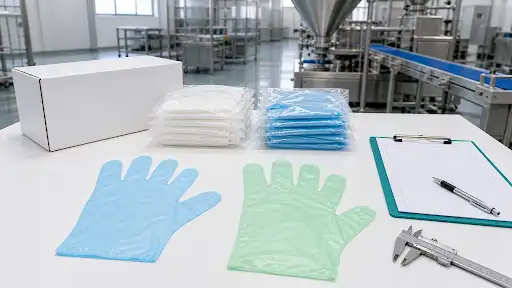
For a food-processing plant, disposable gloves are a production input, not a last-minute consumable. The right supplier must deliver consistent protection, usable specifications and documentation that matches the exact product being ordered.
Table of Contents
Why Supplier Qualification Matters
Glove price is easy to compare. Supplier reliability is not. A small change in film weight, cuff length, packaging or delivery timing can affect hygiene routines, changeover speed and labor cost across an entire production line.
The risk is greater when a plant buys through a distributor that cannot explain where the gloves were made or which specification applies to each carton. If a quality question appears later, buyers need to identify the affected product, lot and delivery window quickly. That is why supplier qualification should happen before the first large purchase order.
A practical qualification process can be organized around six questions.
1. Can the Supplier Match Gloves to the Actual Workstation?
There is no single “best” disposable glove for every food-processing task. A receiving area, a wet trimming station and a ready-to-eat packaging line may have different requirements for grip, coverage, change frequency and operator comfort.
Before comparing suppliers, document the work being performed:
- Is the task dry, wet, oily or exposed to cleaning chemicals?
- How long does one glove typically remain on the operator’s hand?
- Are gloves changed between products, allergens or sanitation zones?
- Does the operator need a short cuff, extended cuff or a glove that fits over a sleeve?
- Will the gloves be dispensed individually at a high-change station?
A supplier that asks these questions is more useful than one that only sends a price list. The goal is to match product design to the job, then standardize the specification so every reorder is comparable.
2. Compare Material and Construction, Not Just the Product Name
Film gloves can look similar while performing differently. PE, CPE and TPE each bring different trade-offs in feel, stretch, grip, weight and cost. Even within one material family, embossing pattern, thickness, cuff opening and sealing quality can change the user experience.
Ask each supplier to state the measurable specification for the exact SKU:
| Specification | Why it matters in a food plant |
| Material | Determines feel, flexibility and suitability for the task. |
| Weight or thickness | Helps compare consistency, durability and cost per change. |
| Embossing and grip | Affects handling of wet packaging, tools and food containers. |
| Dimensions and cuff | Controls coverage, fit and compatibility with sleeves or aprons. |
| Packaging format | Influences dispensing speed, storage space and contamination control. |
Buyers who need a material primer should review the differences between CPE, PE and TPE before requesting samples. The important point is to compare like with like: a lower quoted price may simply reflect a lighter glove or a different packing quantity.
3. Request Documentation for the Specific SKU
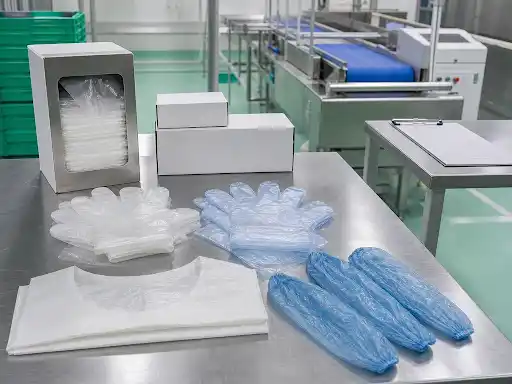
“Food grade” is not a complete purchasing specification. Documentation should identify the product, material and intended market, rather than making a broad claim about an entire factory or product range.
Depending on the destination market and the plant’s quality system, ask for the documents that apply to the ordered SKU. These may include a product specification sheet, material declaration, food-contact statement, test report, packaging details and lot or batch identification method.
If a supplier references a quality or food-safety certification, confirm the certificate holder, scope, issuing organization, expiry date and covered site. Keep the approved documents with the supplier record so the quality team can check that a future shipment has not silently changed material or construction.
4. Test Samples Under Production Conditions
A sample that feels acceptable in an office may fail on a cold, wet or fast-moving line. Run a controlled trial at the workstation where the gloves will be used. Include the operators who will actually wear them and record observations in a consistent format.
Useful trial measurements include:
- time required to put on and remove the gloves;
- unplanned glove changes caused by tearing or loss of grip;
- fit differences between left and right hands;
- ease of taking one glove from the dispenser;
- compatibility with aprons, sleeve covers and other PPE; and
- operator complaints after a full shift.
For wet operations, test the glove with the actual packaging, tools and surfaces used on the line. For high-change areas, measure total cost per task rather than cost per carton. A slightly more expensive glove may reduce interruptions and waste if it is easier to change and less likely to split.
5. Check Manufacturing Consistency and Traceability
Qualification is not finished when the first sample passes. A plant needs confidence that the tenth shipment will match the approved sample. Ask how the supplier controls raw-material changes, dimensions, weight, sealing and packing counts.
Also clarify how a shipment can be traced. A useful system should connect the carton or case to a production lot, manufacturing date and product specification. This makes investigation faster if a defect, packaging error or customer complaint is reported.
Before approval, define what requires notification and re-testing. Examples include a resin change, a new production site, a change in glove weight, a revised package count or a change to the printed product information.
6. Evaluate the Supplier’s Ability to Support Reorders
Food plants rarely need a one-time shipment. They need repeatable supply across multiple sizes, pack formats and production schedules. Ask about standard lead times, minimum order quantities, sample timing, production capacity, export packaging and communication during a delay.
A supplier can be commercially suitable even when it does not offer every possible glove type. What matters is whether it can maintain the approved specifications and provide a clear escalation path when demand changes.
For plants buying several disposable items, it may also be efficient to assess gloves and aprons as one PPE program. The same specification questions apply to coverage, material and packaging across the wider disposable PPE range.
A Simple Approval Scorecard
Use a written scorecard so the final decision does not depend on price alone.
| Qualification area | Pass criteria |
| Application fit | Glove design matches the workstation and changeover routine. |
| Specification control | Material, weight, dimensions and packaging are clearly defined. |
| Documentation | Required product and food-contact records are available for the SKU. |
| Production trial | Operators can use the gloves safely and efficiently under real conditions. |
| Traceability | Lots, dates and changes can be identified after delivery. |
| Supply support | Lead time, MOQ, samples and escalation contacts are acceptable. |
The Bottom Line
Qualifying a disposable glove supplier is a risk-control exercise disguised as a purchasing task. Start with the workstations, define the exact specification, verify documents for the actual SKU and test the gloves where they will be used. Then confirm that the supplier can reproduce the approved product and trace every shipment.
For plants that need a broader sourcing program, a specialized food-processing PPE supplier program can help connect gloves, aprons and related disposable protection to one documented purchasing process.
About the author: This article was contributed by a B2B food-processing and disposable PPE sourcing specialist focused on practical supplier qualification and production-line requirements.